Native flower bulbs (Set 2)
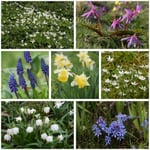
Native flower bulbs (Set 2)
- Ensuring species diversity with native flower bulbs
- For almost all garden locations
General Information
This package contains:
Wood anemone 10 pieces (Anemone nemorosa) The plant prefers bright spring locations under deciduous trees and shrubs with loose, humusy soil. It moves in after flowering. This time depends on the soil moisture: the drier the soil, the earlier. Grows to a height of about 15 cm. Flowering time from March to April. Grading size I.
Dog's tooth lily 3 pieces (Erythronium dens-canis) A bright spring location under deciduous shrubs or at the edge of shrubs that remains cool and shady in summer is ideal. The soil should be well-drained, rich in humus and nutrients and not too dry, especially in spring. Grows to a height of 10 to 15 cm. Flowering time: March-April. Grading size I.
Vineyard grape hyacinth 10 pieces (Muscari neglectum) The plant makes few demands on the soil: it can be fresh to dry and sandy to loamy. It is important that no waterlogging can occur. Always choose a sunny location. Grows to a height of around 20 cm. Flowering time: March-April. Grading 5/+.
Yellow wild daffodil 10 pieces (Narcissus pseudonarcissus ssp. lobularis)This wild daffodil thrives in sun and partial shade with rather loamy, also clayey, humus-rich, fresh to moist soil. Meadows or woodland edges with sufficient soil moisture are well suited. Growing height 25-30 cm. Flowering time from March to April. Grading 5/+.
Umbellate milk star 20 pieces (Ornithogalum umbellatum) The plant thrives best at the sunny edge of shrubs, under large trees or in beds under late sprouting shrubs and perennials. A well-drained soil without waterlogging is important, otherwise the cone milk star is very adaptable. Grows to a height of 15 to 25 cm and flowers from March to May. Grading 7/+.
Two-leaved blue star 20 pieces (Scilla bifolia) Suitable for both sunny and shady locations; a nutrient-rich, preferably acidic soil with constant moisture is important. The plant tolerates root pressure and is therefore well suited for planting under trees. Grows to a height of about 10 cm. Flowering time: March. Grading 5/+.
Marchberry 5 pieces (Leucojum vernum) The plant thrives in moist, nutrient-rich, rather heavy and preferably acidic soil in shade or partial shade. Caution: The marsh fritillary is poisonous. Reaches a height of 20-30 cm. Blooms from February to March. Grading size I.
Colorful all year round. With flower bulbs
When you think of flower bulbs, you usually think of the colorful fireworks of tulips, hyacinths and daffodils in April and May. However, bulbous plants bring color to the garden not only during this short period, but also from the end of February through to the summer, making them an indispensable part of any mixed border planting.
We offer you a wide selection, from low to tall growth, in many different colors and shapes, for large areas and small niches and sometimes also for cut flowers. A variety of plants that goes beyond what is widely available and ensures that the wish that "perennial pope" Karl Foerster gave as an introduction to his flower bulb book is fulfilled - that garden lovers can finally look through garden fences with curiosity without just the old feeling: "Oh, I have that in my garden too - blooms a little later in my garden, stands here on a warm house wall." All the bulbs we offer come from controlled horticultural propagation and are not taken from wild stocks.
Product Information
Article Number 217694
- Ensuring species diversity with native flower bulbs
- For almost all garden locations
The naturally occurring species of our local flora are referred to as native wild plants - these can be trees and shrubs or herbaceous plants such as perennials, annual and biennial flowers or the diverse group of bulbous plants. Some are widespread, while others are almost non-existent and are on the Red List as endangered species. In principle, however, these plants have adapted to our environmental conditions for thousands of years and are therefore often easier to care for, more robust, more vigorous and more frugal than cultivated species or plants introduced from other areas of origin. In addition, they are generally of high ecological value, as they provide food for a diverse animal world or, in extreme cases, ensure the survival of some highly specialized native insects that can only survive in association with certain plant species. But it is also important to ensure the preservation of these valuable plants themselves, as many species can hardly be found in their natural habitat due to over-fertilized soils, falling groundwater levels or extensive sealing. Offering them a place in the garden is therefore an important contribution to preserving the diversity of native flora.
Our selection offers plants for almost all garden locations: from sunny to shady and from dry to moist. All information on location, planting and care can be found on the packaging of each variety.
Have a question?
If you have a question concerning this product you are welcome to contact us. For this your E-Mail program will open.
---------- --------------



Customer service
Whether its advice, spare parts, or special requests - all your questions and concerns are handled personally and thoroughly by our customer service.
You can contact us anytime at info@manufactum.dk