Herder back tip
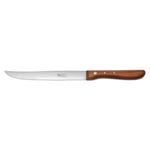
Herder back tip
- Separates meat and fish from bones and bones
- Can be used with pinpoint accuracy: fine tip and curved bevel
- High-grade carbon steel: min. 0.75% carbon content
---------- --------------

General Information
Knife handles made of steamed, finely polished wood are rare. Knife handles made of steamed, finely polished apple tree wood are even rarer because apple tree wood, since it dries slowly, is not one of the typical commercial woods. However, it is very easy to work with due to its hardness, weight and durability. Herder in Solingen manufactures these knife handles with rarity value exclusively for Manufactum: even oiled for better surface protection.
For fine cuts
The blade of a filleting knife must be long and narrow. The blade of this knife is also sharpened in such a way that it can be set with pinpoint accuracy, swinging as it is, with the help of the very fine tip and thanks to the defined curved bevel. The "back point" separates raw and cooked meat or fish from bones. Even, long cuts, for example to obtain wafer-thin slices of ham or tenderly cooked roast beef, are also possible.
Solingen thin grind: nail-thin and scrape-free
The Windmühlen knives from Robert Herder in Solingen are remarkable not only because of the knife steel (at least 0.75% carbon content and a hardness of at least 56 HRC for the carbon steels), but above all because of the craftsmanship, which spares none of the traditional grinding efforts: Windmühlen knives are ground extremely thin. This results in their astonishing cutting ability, which is an experience in use. The most elaborate type of sharpening is fuller grinding, a special type of thin grinding in which the blade is tapered towards the back of the knife.
Blaugepließtet
In Solingen, the process of smoothing the grinding grooves remaining on the blade is known as flattening, i.e. fine grinding. The most complex stage of this technique is blue polishing. The steel is ground finer step by step. You can tell that a blade is blue-fluted because it reflects slightly blue in the light.
Sharp for longer thanks to greater hardness
The elastic blades of the blue-blued knives from Herder are ground using the Solingen thin grind and fuller's edge. Thanks to the very high hardness of 60 Rockwell (HRC), they keep their sharpness significantly longer. However: Due to the high hardness - and precisely because they are ground so extremely thin - the blades should not be twisted or even tilted, as this can lead to chipping of the material when cutting.
Not stainless, but really sharp
The traditional material for knife blades is carbon steel. It is not rustproof, but with a fine-grained structure it can be hardened to a particularly high degree and made extremely sharp. The higher the carbon content, the higher the hardening capacity. These knives owe their high cutting ability to the material in addition to the finish, and their high cutting edge retention to a material-related self-sharpening effect. Each time a cut is made through fruit or vegetables, a minimal amount of material is removed and the blade wears evenly. The knifemaker refers to this as micro-corrosion. In fact, this means that the blade becomes steadily narrower over the years - but always retains its sharp grinding angle. Blades made of carbon steel acquire a dark patina over time, but this in no way negatively affects their quality; on the contrary, it gives them better protection against corrosion.
Care instructions:
Carbon steel knives do not belong in the dishwasher. Wipe the knives dry after rinsing and occasionally apply some blade oil. Discoloration may occur on the blade material. However, this is not a sign of inferior quality, but only indicates the rather high carbon content in the material. In case of flash rust, the use of the rust eraser is recommended. A resharpening can be done with the sharpening steel.
Product Information
Article Number 67178
- Separates meat and fish from bones and bones
- Can be used with pinpoint accuracy: fine tip and curved bevel
- High-grade carbon steel: min. 0.75% carbon content
Carbon steel blade, finely sharpened. Handle made of steamed apple tree wood. Blade length 17.5 cm, total length 30 cm. Weight 60 g.
The "Rückenspitz" is perfect for effectively deboning of raw or cooked meat or fish. The blade is sharpened in such a way that it oscillates and can therefore be used with extreme precision - as should be the case with a filleting knife. And for even, long cuts, for example to obtain wafer thin slices of ham or tenderly cooked roast beef, the "Rückenspitz" is also the first choice of knife.
Have a question?
If you have a question concerning this product you are welcome to contact us. For this your E-Mail program will open.


Customer service
Whether its advice, spare parts, or special requests - all your questions and concerns are handled personally and thoroughly by our customer service.
You can contact us anytime at info@manufactum.dk


Exclusive at Manufactum
Several particularly noteworthy products from selected manufacturers are available from us in a distinct form. In any case, these special editions offer you a maximum of quality in material and functionality.
Find exclusive products